

Recovering From a Relationship With a Narcissist
It can take a long time to recover from a relationship with someone who is narcissistic.
You may know that the relationship wasn’t good for you. You may even have been the one who ended it. But knowing this doesn’t necessarily make the aftermath any easier.
You may still find yourself going over conversations in your head, trying to work out what really happened. You may miss the person. You may be angry with them. You may feel relieved that the relationship is over and then, rather inconveniently, find yourself longing for them the next day.
Sometimes the end of a narcissistic relationship brings relief. Sometimes it brings grief. Quite often it brings both.
Recovery isn’t simply a matter of recognising that someone treated you badly and moving on. If you have spent a long time in a relationship where your feelings, perceptions or needs were repeatedly dismissed or undermined, you may come out of it with much less confidence in yourself than you had going in.
You may also have become very used to thinking about the other person.
What are they feeling? What will they do? What did they mean by that? Why did they behave that way? Were they deliberately trying to hurt you? Did they ever really love you?
These questions can become consuming.
At some point, recovery involves turning your attention away from the narcissistic person and back towards yourself. This is not always easy. In some relationships, losing sight of yourself has been part of the problem.
Why can recovery from a narcissistic relationship be so difficult?
Relationships with people who have strong narcissistic traits can become very one-sided.
Your partner’s feelings, needs and version of events may gradually take precedence over your own. Disagreement can be treated as criticism. Attempts to raise a problem may somehow end with you defending yourself. You may find yourself becoming increasingly careful about what you say, when you say it and how you say it.
Over time, you adapt.
You learn which subjects are best avoided. You anticipate moods. You try to explain yourself more clearly, hoping that this time you will be understood. You may give in simply because you can’t face another argument.
None of this necessarily happens overnight.
In fact, that is part of what can make these relationships so difficult to understand. The loss of confidence in yourself, and sometimes the loss of a sense of who you are, can happen by degrees.
You may also become unusually preoccupied with anticipating your partner’s reactions. What mood are they in? Is it safe to raise this now? Will they become angry, withdraw, accuse you of something, or turn the conversation back on you?
For some people this kind of vigilance is already familiar. An insecure attachment pattern can make us particularly sensitive to changes in closeness, signs of rejection or the possibility that a relationship is under threat. Living with an unpredictable or highly reactive partner may intensify this.
For others, it may develop largely in response to what has been happening in the relationship itself.
Either way, you can become very good at monitoring the other person while becoming less certain about what you think, feel or want.
And this doesn’t necessarily stop when the relationship ends.
You may have lost trust in your own perceptions
One of the more disturbing consequences of a relationship like this is that you may become unsure of what you know and what you don’t know.
This is particularly likely when gaslighting has been part of the relationship. The term is used rather loosely these days, sometimes to describe almost any disagreement. But gaslighting is something more specific. It involves repeatedly undermining another person’s confidence in their own perception of events.
Something happened, but you’re told it didn’t.
Something was said, but apparently you’ve remembered it incorrectly.
You are hurt or angry about something, but your reaction is seen as problematic. You’re too sensitive. You’re making a fuss. You’re imagining things.
Sometimes the distortion is deliberate. Sometimes the other person may genuinely believe their own version of events. From your point of view, the effect can be much the same. You begin to doubt yourself.
After a while, you may not need the other person to do this for you. You do it yourself. This may be a habit you have developed from childhood, but it also may be something that has been created in the crucible of a narcissistic relationship.
Instead of simply thinking, I’m angry about this, another thought follows almost immediately. Do I have a right to be angry? Am I overreacting? Have I misunderstood? While we all doubt ourselves from time to time, being involved in a relationship characterised by narcissistic behaviour can create ongoing problems, including chronic self-doubt.
This kind of self-doubt can persist long after the relationship is over.
Part of recovery is learning to take your own experience seriously again. To ground yourself and stand by your own feelings and opinions.
Missing someone doesn’t mean the relationship was good for you
One of the more confusing parts of leaving a difficult relationship is discovering that you can still miss the person.
People sometimes take this as evidence that they have made a mistake. If the relationship was really so damaging, why would they want the person back? Why are they still thinking about them? Why do they remember the good times, sometimes with almost painful clarity, while temporarily forgetting the reasons they left?
But attachment doesn’t disappear simply because you have reached an intellectual conclusion about a relationship.
You may miss affection, companionship, sex, shared jokes and ordinary routines. You may miss having someone beside you in bed or someone to tell about the strange thing that happened on the way home. You may miss the person themselves.
You may also be grieving the relationship you hoped you were going to have. This can be particularly painful when there were periods of genuine closeness, or when the beginning of the relationship seemed to promise something quite different from what followed.
There is a tendency when talking about narcissistic relationships to divide everything rather neatly into what was real and what wasn’t. Human relationships are rarely quite so simple. A relationship can contain love, pleasure, tenderness and genuine attachment and still become destructive or impossible to live with.
Nor does missing someone mean that leaving was the wrong decision.
You can love someone and decide that you cannot live with them. You can miss them and still recognise what the relationship was doing to you.
Both things can be true.
Understanding why you stayed
After a relationship has ended, people often become preoccupied with another question. Why did I stay?
Sometimes the question is asked with curiosity, but often there is a fair amount of self-criticism attached to it. You may look back and see things that now seem obvious. Perhaps there were warning signs early on. Perhaps you left and went back, sometimes more than once. Perhaps friends or family could see what was happening long before you were ready to acknowledge it yourself.
There is rarely one simple explanation.
You may have stayed because you loved the person, because there were good periods as well as bad ones, or because you kept hoping that things would change. Children, money, housing, isolation, fear and the sheer practical difficulty of dismantling a shared life can all play a part. If your confidence has been steadily undermined over time, making a major decision about your future may also become considerably more difficult.
Your own history may be relevant too.
If relationships in childhood were unpredictable, emotionally neglectful or required you to pay close attention to the needs and moods of other people, some aspects of an adult relationship may feel familiar. An insecure attachment pattern may also make the prospect of losing a relationship particularly difficult to tolerate, even when the relationship itself is causing considerable distress.
But childhood history is not destiny, and it doesn’t provide a neat explanation for why one person stays and another leaves. Nor does having remained in a relationship tell us that you were unconsciously seeking abuse or trying to recreate your childhood.
People stay in difficult relationships for complicated reasons.
Understanding your own reasons can be useful. Blaming yourself for them generally isn’t.
Rebuilding your sense of self
One of the casualties of a narcissistic relationship can be your sense of yourself as a separate person.
This doesn’t necessarily mean that you have completely lost touch with who you are. More often, parts of yourself have been pushed into the background. Your preferences, opinions, friendships, interests and even quite ordinary wants may have become less important than keeping the relationship functioning.
You may have become used to compromise, but without much compromise coming back the other way.
Recovery can involve noticing these things again. What do you actually like? What do you want to do with your time? Who do you enjoy being with? What matters to you when you are not organising yourself around somebody else’s reactions?
Some of these questions can feel oddly difficult.
Boundaries are part of this too. If saying no, disagreeing or asking for something you needed regularly resulted in anger, withdrawal, ridicule or accusations of selfishness, it makes sense that asserting yourself may have become fraught.
After the relationship ends, you may continue to avoid conflict, explain yourself at enormous length or feel guilty when you disappoint someone. These habits can turn up in friendships, family relationships and new intimate relationships, even when the other person is not asking you to behave this way.
Rebuilding a sense of self is partly about recognising that being in a relationship does not require you to disappear inside it.
You remain a separate person.
That sounds obvious. In practice, it may take some getting used to.
Learning to trust yourself again
Learning to trust yourself again is closely connected to rebuilding your sense of self, but it is not quite the same thing.
If you have spent years having your perceptions questioned, your feelings dismissed or your decisions criticised, you may find that even relatively ordinary choices become difficult. You can know what you think and then immediately begin arguing yourself out of it.
Sometimes this shows up as an almost endless need to check. You ask friends what they think. You explain the situation in great detail. You go over conversations in your head, looking for the point where perhaps you got it wrong. You may find yourself wanting someone else to confirm that what happened really was unreasonable before you feel entitled to believe it yourself.
Of course, there is nothing wrong with asking other people what they think. We all need other minds around us, particularly when something is complicated. The problem is when another person’s opinion begins to feel more reliable than your own simply because it belongs to somebody else.
Trusting yourself doesn’t mean assuming that you are always right. None of us is.
It means being able to tolerate the possibility that you might be wrong without automatically assuming that you are. It means listening to other people without immediately abandoning your own position, and being able to change your mind because something genuinely makes sense to you rather than because disagreement has become unbearable.
This takes time.
But gradually, the question can shift from What would they think about this? or What am I supposed to think? to something much simpler.
What do I think?
What does recovery actually look like?
Recovery from a narcissistic relationship is not necessarily about reaching a point where you never think about the person again, or where what happened no longer matters.
It may be less dramatic than that.
You might notice that you are spending less time trying to understand the other person. The endless questions about why they behaved as they did, whether they knew what they were doing, whether they really loved you, or whether things might have turned out differently begin to lose some of their urgency.
Your emotional life may become less organised around the relationship.
You may find that you can remember something that happened without being pulled back into it for the rest of the day. Anger may still come and go, as may sadness and grief, but these feelings no longer dominate quite so much of your internal world.
Recovery can also be quite ordinary. Making a decision without needing someone else to confirm it. Saying no without spending the next three hours worrying about whether you were unreasonable. Rediscovering people and things you had neglected. Becoming interested in your own life again.
For some people, recovery also involves coming to terms with the fact that they may never completely understand what happened. There may be no final explanation of the other person’s behaviour that makes everything fall neatly into place.
Eventually, understanding yourself may become more important than understanding them.
That can be a significant shift.
What about another relationship?
After a difficult relationship, the prospect of becoming involved with someone else can be complicated.
You may be wary of trusting another person. You may scrutinise their behaviour for signs that you have somehow ended up in the same situation again. Or you may find yourself particularly sensitive to withdrawal, criticism or changes in the other person’s mood.
Some caution is understandable. Experience changes us.
But there is no requirement to become perfectly healed before having another relationship. In fact, some things can only really be discovered in relationship with another person.
A new relationship may bring old fears to the surface. This doesn’t necessarily mean that there is something wrong with the relationship, nor does it mean that your concerns should automatically be dismissed as the legacy of the past. Sometimes your alarm bells are telling you something useful. Sometimes they are responding to something that belongs partly to an earlier experience.
Working out the difference can take time.
A healthier relationship will not be one without conflict, disappointment or misunderstanding. The difference may lie in what happens when these things occur. Can you disagree without being punished for it? Can both people have needs? Can one person say no? Can either of you admit to being wrong? Can you remain yourself while being close to someone else?
These are less dramatic questions than Is this person a narcissist?
But in the long run, they may be more useful.
Recovering from a narcissistic relationship
There is no single timetable for recovering from a relationship like this.
For some people, the end of the relationship brings an immediate sense of relief. For others, disentangling themselves emotionally takes much longer. You may move backwards and forwards between anger, grief, relief, longing and a desire to understand what happened.
The task is not necessarily to forget the relationship or to arrive at some point where you are completely unaffected by it.
It is to find your way back to yourself.
This may involve understanding patterns that existed before the relationship as well as those that developed within it. It may mean becoming more comfortable with boundaries, recognising your own needs, tolerating disagreement and learning that closeness does not have to come at the expense of your independence.
Sometimes psychotherapy can help with this, particularly when the relationship has connected with older difficulties around attachment, self-worth or trust.
But recovery also happens in ordinary life. Through friendships. Through solitude. Through making decisions. Through discovering what you like when nobody else is telling you what you ought to like.
And, gradually, through becoming less interested in the narcissistic person and more interested in yourself.
If you are trying to understand why relationships characterised by intensity, idealisation and emotional confusion have felt familiar, you may find this short guide helpful.
Why Do I Keep Ending Up in These Relationships? is a brief, clinically grounded guide to understanding attachment, intensity and repeated relational patterns.
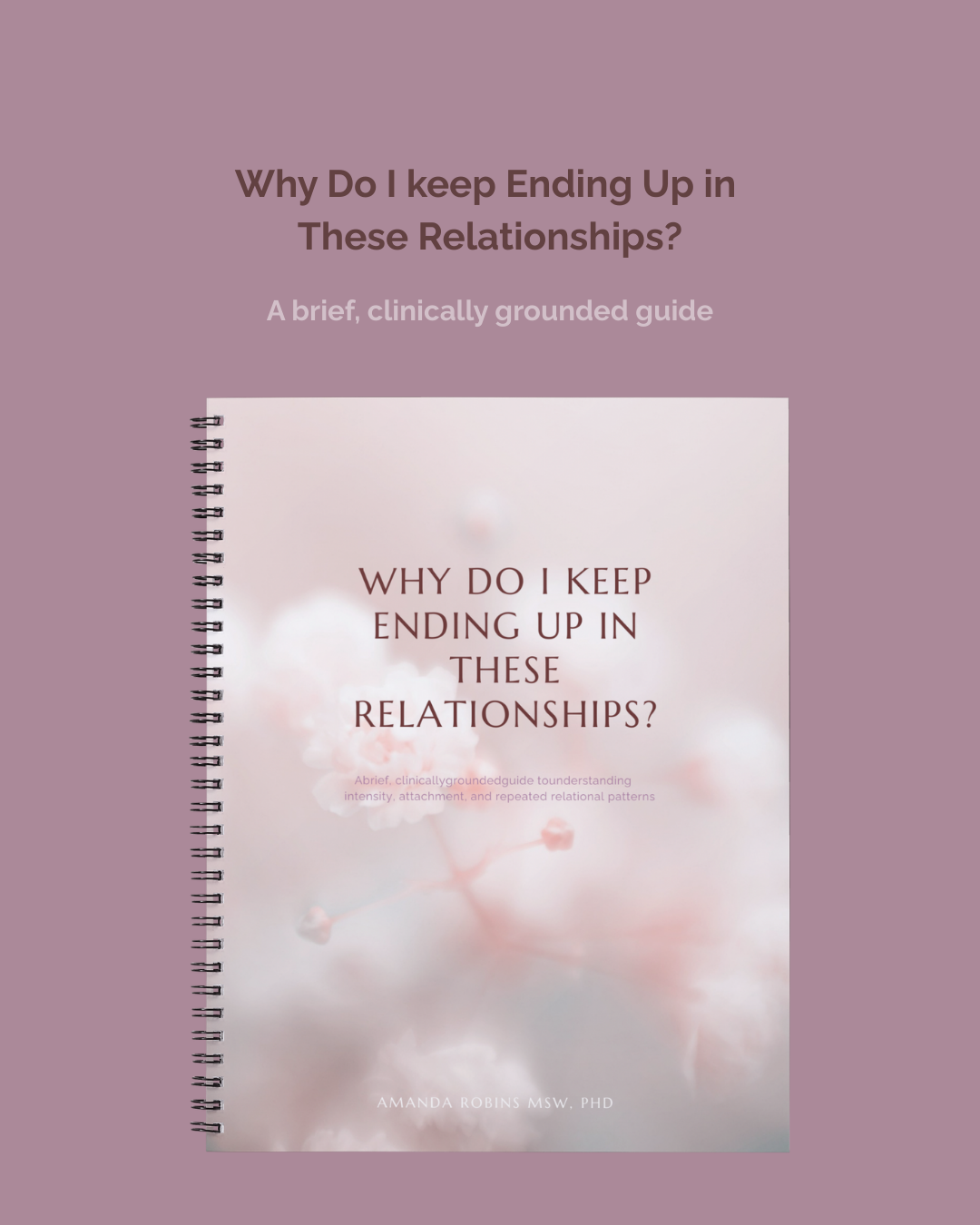
Free Guide: Why Do I Keep Ending Up in These Relationships
Therapy after a narcissistic relationship
If you are struggling with the aftermath of a narcissistic relationship, psychotherapy can provide a place to understand what has happened, including the impact the relationship may have had on your sense of self, your capacity to trust yourself and your relationships with other people.
I work with people across Australia via Zoom.
More about Narcissism from the Recovery Room











Coming into the orbit of someone who is narcissistic can be exciting, confronting and dangerous. How can we recognise what is happening and why we are seduced?