

Why “love” from a narcissist feels intoxicating at first — and devastating over time.
Why “I Love You” Feels Different When It Comes From a Narcissist
Those three words can be extraordinarily powerful. When you are in a relationship with someone who is narcissistic, “I love you” may trigger hope, longing and reassurance — but also confusion, anxiety or self-doubt.
The difficulty is that someone can say they love you while behaving in ways that leave you feeling controlled, diminished or emotionally unsafe. You may find yourself wondering whether the love is real, whether they mean what they say, or whether you are expecting too much.
There isn’t a simple answer to the question of whether narcissists are capable of love. People with narcissistic traits are not all identical, and narcissism exists on a spectrum. But significant narcissistic traits can profoundly affect a person’s capacity for mutuality, empathy, accountability and emotional intimacy.
So rather than asking only “Does this person love me?”, it can be more useful to ask: “What does love actually look and feel like in this relationship?”
For people who grew up with a narcissistic or emotionally unavailable parent, this question can be particularly complicated. If love was associated with criticism, intrusion, conditional approval or having to accommodate somebody else’s needs, similar dynamics can feel strangely familiar in adult relationships.
For a deeper explanation of why boundaries feel emotionally charged in relationships with narcissistic partners or parents, read more about the mother wound here.
How Narcissistic Traits Can Affect Love and Attachment
People with significant narcissistic traits may experience attachment and intimacy differently. Although they may want closeness, admiration and reassurance from others, genuine intimacy also requires being able to recognise another person as separate — with needs, feelings and perspectives that may not always coincide with their own.
This can become difficult when a person relies heavily on relationships to regulate self-esteem or protect themselves from feelings of shame, inadequacy or vulnerability. A partner’s disagreement, independence or need for space may then be experienced not simply as difference, but as rejection or criticism.
As a result, relationships can become organised around maintaining the narcissistic person’s emotional equilibrium. Their partner may gradually find themselves monitoring moods, avoiding disagreement, providing reassurance or putting their own needs aside in order to keep the relationship stable.
This doesn’t necessarily mean that the narcissistic person feels nothing or is consciously manipulating their partner. But their capacity for love may be constrained by their difficulty tolerating vulnerability, mutual dependence and the separateness of another person.
For the person on the receiving end, the important question is often less whether the narcissistic person experiences love, and more whether there is enough room in the relationship for both people to exist as separate, equally important human beings.
Love-Bombing, Mirroring and Idealisation
Relationships with highly narcissistic people can begin with an unusual degree of intensity. You may feel exceptionally seen, admired or understood. There may be frequent contact, strong declarations of feeling, rapid emotional closeness or a sense that you have finally met someone who understands you completely.
This early intensity is sometimes described as love-bombing. In some relationships it may be deliberately manipulative, but it does not always need to be consciously calculated. A person may genuinely idealise a new partner and experience the relationship as unusually exciting or important.
The difficulty is that idealisation is not the same as knowing another person deeply. When someone is idealised, they can become a projection of what the other person hopes or needs them to be.
As the relationship develops and you inevitably reveal your own needs, preferences, limitations and differences, that idealised image becomes harder to maintain. The intense admiration of the beginning may give way to disappointment, criticism, withdrawal or attempts to regain the earlier dynamic.
This can be profoundly confusing for the person on the receiving end. You may keep trying to recover the closeness you experienced at the beginning, wondering what changed — or what you did wrong.
What Does “I Love You” Mean to a Narcissist?
When someone with significant narcissistic traits says “I love you”, they may genuinely experience strong feelings of attachment, desire, admiration or need. The difficulty is that these feelings do not necessarily translate into the mutuality, empathy and recognition that a healthy intimate relationship requires.
Love involves being able to recognise another person as separate from ourselves — someone whose needs, feelings and wishes matter even when they conflict with our own.
For someone whose self-esteem depends heavily on admiration, reassurance or validation from other people, a partner can become important partly because of the emotional function they provide. Being loved, admired or needed may help them feel secure, valued or significant.
This can create a confusing contradiction. They may feel strongly attached to you and still struggle to consider your needs. They may say they love you and become angry when you disagree with them. They may fear losing you while simultaneously behaving in ways that undermine the relationship.
So the question is not necessarily whether their declaration of love is true or false. A more useful question may be whether the way they experience and express love allows for reciprocity, accountability, empathy and your right to remain a separate person.
That distinction matters because being intensely wanted or needed is not necessarily the same thing as being loved well.
When Love Turns to Contempt: Shame, Rage & the Fall From the Pedestal
The intense admiration of the early relationship can be difficult to sustain. As you become more familiar to one another, you inevitably become less able to fit the idealised image that may have characterised the beginning.
You have your own opinions. You disagree. You need things. You may want more independence, question their behaviour or simply fail to provide the admiration and reassurance they have come to expect.
For someone with significant narcissistic traits, these ordinary expressions of separateness can sometimes feel surprisingly threatening. Disagreement may be experienced as criticism, a boundary as rejection, or your independence as evidence that you no longer value them.
Shame can be important in understanding these reactions. When a person’s sense of self is fragile, experiences that evoke inadequacy, humiliation or rejection can be extremely difficult to tolerate. Rather than experiencing and reflecting on those feelings, they may defend against them through anger, blame, withdrawal, contempt or by locating the problem in somebody else.
This can produce a bewildering change in the relationship. The qualities that were once admired may now be criticised. Your independence may be described as selfishness. Attempts to discuss problems may be interpreted as attacks. You may find yourself increasingly careful about what you say or do because you cannot predict what will provoke anger or withdrawal.
For the person who was initially placed on a pedestal, this change can be particularly destabilising. You may keep comparing the relationship with its beginning and wondering how you can get back to the person who once seemed so attentive and loving.
But the more useful question may be not “How do I get the old relationship back?” but “What is actually happening in the relationship I have now?”
Why Narcissistic Relationships Can Decline Over Time
Research on narcissism and romantic relationships helps explain why these relationships can feel so different at the beginning.
Research by Brunell and Campbell has found that narcissistic characteristics can actually make someone appear particularly appealing during the early stages of a relationship. Confidence, charm and a willingness to initiate relationships can contribute to positive first impressions.
Over time, however, some of the same characteristics can create difficulties in maintaining satisfying intimate relationships. Narcissism has been associated with greater attention to alternative partners, game-playing, a focus on self-enhancement and difficulties sustaining the mutuality that longer-term relationships require.
This helps explain an experience that can otherwise be extremely confusing: the beginning of the relationship may have felt genuinely wonderful. You don’t necessarily have to conclude that you imagined it or were foolish to respond to it.
The problem is that being very good at initiating intimacy is not the same as being able to sustain it.
Long-term relationships inevitably require compromise, accountability, empathy and the capacity to tolerate another person’s separateness. When these become difficult, the relationship that initially felt unusually intense or close may gradually become much more one-sided.
How to Decode “I Love You”: What Survivors Most Need to Know
If you are trying to understand what a narcissistic partner means when they say “I love you”, it can be tempting to analyse the words themselves. Do they really mean it? Are they manipulating you? Were their feelings ever genuine?
But their behaviour may tell you considerably more than the declaration itself.
Rather than asking only whether they love you, notice what happens when your needs differ from theirs. Can you disagree without being punished, criticised or withdrawn from? Can you set a boundary? Is there room for your feelings when they are inconvenient? Can they acknowledge having hurt you and take responsibility for repairing the relationship?
Someone may experience powerful feelings for you and still be unable to participate in the kind of reciprocal relationship you need.
This is particularly important when declarations of love are followed by behaviour that repeatedly leaves you feeling confused, diminished or responsible for maintaining the relationship. The words “I love you” do not cancel out what happens between those declarations.
Healthy love allows for two separate people. It involves curiosity about the other person’s experience, respect for their autonomy, the capacity to tolerate difference and a willingness to repair the relationship when harm occurs.
So if you find yourself repeatedly asking “Does this person really love me?”, another question may ultimately be more useful:
“Does the way this person loves me allow me to remain myself?”
Why Some Narcissistic Relationships Can Feel So Familiar
For some people, the intensity and uncertainty of a narcissistic relationship can feel strangely familiar.
If you grew up in a family where love was conditional, unpredictable or closely tied to meeting another person’s emotional needs, you may have learned very early to monitor other people and adapt yourself in order to maintain connection.
You may have learned that being loved meant being pleasing, accommodating or useful. Expressing your own needs might have resulted in criticism, withdrawal or conflict. Over time, beliefs such as “my needs are a burden”, “I have to keep other people happy” or “disagreement is dangerous” can become deeply embedded.
This can affect what feels familiar in adult relationships. Intensity may be mistaken for intimacy. Emotional unpredictability can create a powerful desire to restore closeness. Being intensely needed may feel like being deeply loved.
This doesn’t mean that everyone who becomes involved with a narcissistic person has experienced childhood trauma, or that your history somehow caused another person to treat you badly.
But if you do recognise these patterns, understanding them can help explain why a relationship that causes considerable distress can nevertheless feel extraordinarily difficult to step away from. It can also help you begin to distinguish between what feels familiar and what actually feels emotionally safe.
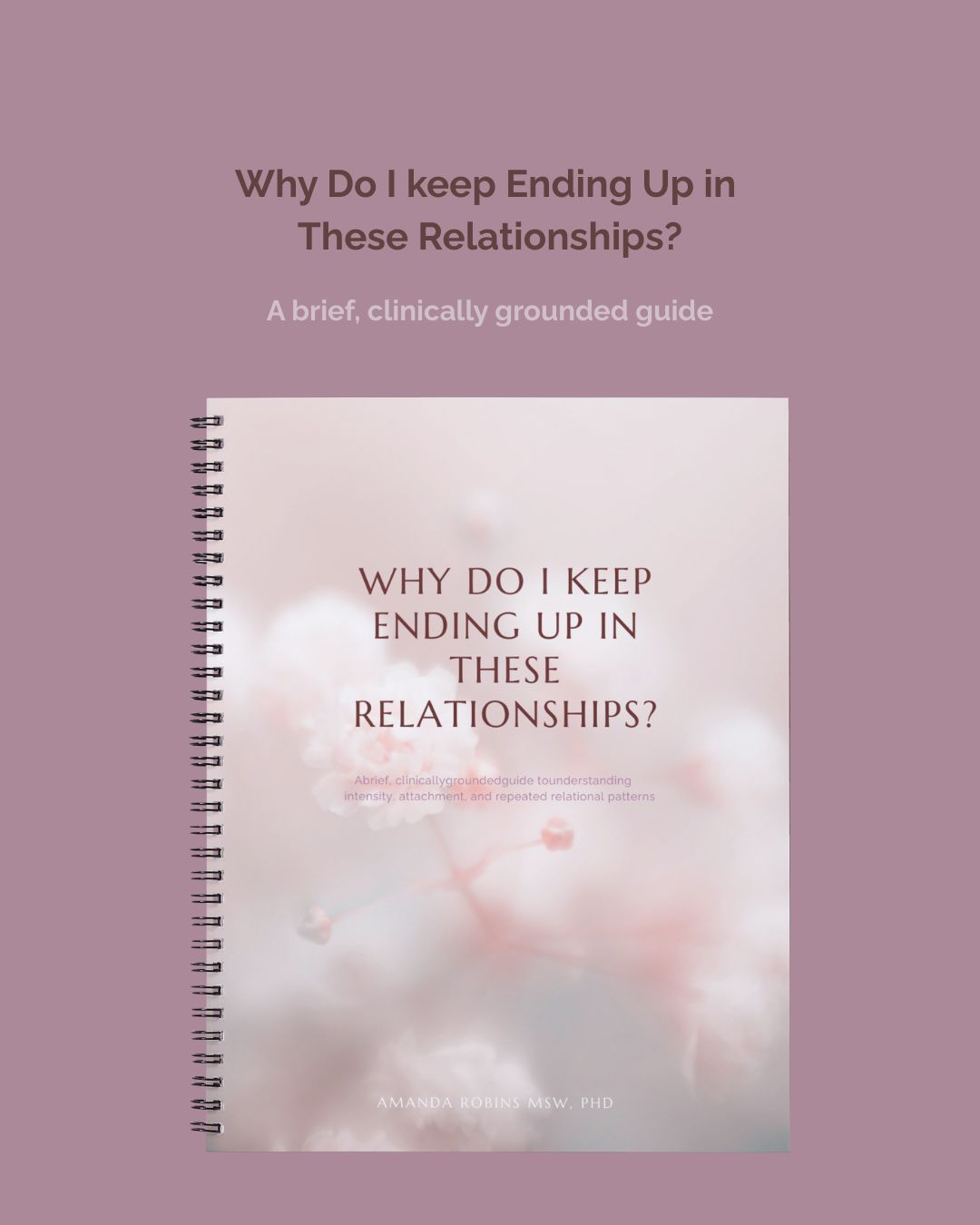
If you are trying to understand why relationships characterised by intensity, idealisation, and emotional confusion have felt familiar — you may find this short guide helpful:
Why Do I Keep Ending Up in These Relationships?
A brief, clinically grounded guide to understanding attachment, intensity, and repeated relational patterns.
For more on these dynamics:
If this article has brought up feelings of shame, self-doubt or confusion about your own responses, my Self-Compassion eBook Bundle offers practical support for understanding these patterns and developing a more compassionate relationship with yourself.


If you’d prefer to explore these issues with me in therapy, you can book an appointment here.
MORE ABOUT NARCISSISM FROM THE RECOVERY ROOM











Why is it so difficult to leave a narcissistic relationship, even when you know it is hurting you? This article explores the practical, emotional and psychological reasons people stay, including fear, isolation, gaslighting, earlier relationship patterns and the hope that things will change.