

In brief
Attachment describes the ways we seek closeness, security and support from other people. Early attachment relationships can influence how we experience intimacy, separation and dependency as adults, but they don’t determine the relationships we will have.
Secure, anxious, avoidant and fearful-avoidant attachment patterns can help us understand some of our responses in relationships. They are most useful when we treat them as patterns rather than fixed explanations for who we are or why every relationship succeeds or fails.
Contents
In this article
What is attachment?
How attachment develops in childhood
Secure, anxious, avoidant and fearful-avoidant attachment
How attachment affects adult relationships
Living with an insecure attachment style
Why attachment isn’t the whole relationship
Attachment and couples therapy
Individual therapy and attachment
Attachment and mental health
You’ve heard about attachment, right?
How you and your partner can have a better, more fulfilling relationship by learning about your attachment styles and how they mesh. Or don’t, as the case may be.
But attachment isn’t just for the romantically involved.
It begins long before we have a partner. In fact, it begins before we have much idea that we are a separate person at all.
Our earliest attachment relationships help us learn what to expect from other people. Can I rely on you? What happens when I need something? Is it safe to be upset? What happens if you go away? Will you come back?
And, eventually, there are other questions.
Can I depend on somebody without losing myself? Can I tolerate being alone? Can I disagree with someone I love without fearing that the relationship is about to collapse? Can I let another person get close to me without feeling trapped?
Attachment can influence our emotional wellbeing, our relationships and the way we respond to closeness, separation, rejection and conflict.
But it isn’t destiny.
Having an insecure attachment pattern doesn’t mean that you are damaged for life, doomed to have terrible relationships or destined to fall in love with a particular kind of person. Human beings are considerably more complicated than that.
What is attachment?
Attachment is, first and foremost, about survival.
Human infants are extraordinarily dependent. We need other people to feed us, protect us, keep us warm and help us manage states that we cannot yet manage for ourselves.
Attachment behaviour helps keep a baby close to the people who can do these things.
Crying, reaching, clinging, following and seeking comfort aren’t signs that a baby is too dependent. Dependency is the whole point. A baby who is frightened, hungry or distressed needs to attract the attention of somebody bigger and considerably more competent.
Over time, something else happens.
Through thousands of ordinary interactions with our caregivers, we begin learning what relationships are like.
Sometimes I am distressed and somebody comes.
Sometimes I need comfort and it is available.
Sometimes the person I need is distracted, frightened, depressed, unpredictable or simply unable to respond in the way I need.
No parent gets this right all the time. Nor do they need to.
Attachment develops within this complicated accumulation of experiences, alongside temperament, development, family circumstances, culture and the many other things that make us who we are.
And those early experiences can matter.
But they are the beginning of the story, not the end.
How does attachment develop in childhood?
Our earliest attachment relationships develop through repeated interactions with the people who care for us.
A baby becomes distressed. Someone responds. The baby is frightened and seeks proximity. Someone provides comfort. The child ventures away to explore and returns when the world becomes a bit too much.
None of this requires perfect parenting.
Parents get tired, distracted, irritated and occasionally get things spectacularly wrong. What matters is not perfect attunement, but the broader pattern of the relationship and whether there is enough responsiveness, safety and repair.
Over time, children develop expectations about what happens when they need other people.
If a caregiver is generally available and responsive, the child is more likely to develop a sense that other people can be relied upon and that their own needs are manageable. This provides a relatively secure base from which to explore the world.
When caregiving is consistently unavailable, frightening, intrusive or unpredictable, children have to adapt.
Some become particularly vigilant about maintaining closeness. Others learn to minimise the expression of attachment needs. In more frightening or chaotic environments, the child may face a much more difficult problem: the person they instinctively turn towards for safety may also be a source of fear.
These adaptations make sense in the environments in which they develop.
But strategies that helped us manage relationships when we were very young don’t necessarily disappear simply because we grow up.
And this is where attachment starts becoming particularly interesting in adult relationships.
What are the different attachment styles?
When people talk about their “attachment style,” they are usually talking about patterns in the way they experience closeness, dependency and emotional security in relationships.
The familiar categories are secure, anxious, avoidant and fearful-avoidant attachment. You may also come across terms such as dismissive-avoidant or anxious-preoccupied, depending on which model is being used.
These categories can be useful. They give us a language for patterns that might otherwise be difficult to see.
But they can also become a bit seductive.
It is very easy to take an online attachment quiz, discover that you are “anxiously attached” and suddenly reinterpret every relationship you have ever had through that lens.
Attachment doesn’t work quite that neatly.
Our responses can vary between relationships and across different periods of our lives. A relationship itself can also make us feel more or less secure. Someone who feels relatively comfortable and trusting with one partner may become considerably more anxious with a partner who is inconsistent or unavailable.
So it is probably more useful to think of attachment styles as patterns or tendencies rather than fixed personality types.
With that qualification in mind, the different patterns can tell us something useful about what happens when we get close to other people.
Secure attachment
People with relatively secure attachment generally find it easier to be close to other people without feeling that they are either going to disappear or swallow them whole.
They can depend on another person and allow themselves to be depended upon.
This doesn’t mean they sail serenely through relationships without jealousy, insecurity, arguments or the occasional completely unreasonable reaction. Securely attached people are still people.
The difference is that difficulties in the relationship are less likely to feel like a fundamental threat to either the relationship or the self.
Anxious attachment
If you have an anxious attachment style, relationships can be hard work.
You can spend an enormous amount of time wondering what is going on in someone else’s head.
Your partner is quieter than usual. They don’t answer a message. They seem distracted. Perhaps they want to spend the evening alone.
And off you go.
Are they angry with me? Have I done something wrong? Are they losing interest?
Before long, something fairly ordinary can turn into a full-scale investigation of the relationship.
Of course, sometimes there really is something wrong.
Your partner may actually be withdrawing. They may be unreliable or inconsistent, or particularly bad at talking about what is going on. If someone repeatedly disappears, threatens to leave or blows hot and cold, anxiety is not necessarily evidence that you have an attachment problem.
Sometimes the relationship is making you anxious.
But if this kind of anxiety follows you from one relationship to another, you may find it particularly difficult to tolerate uncertainty or distance. You might need a lot of reassurance. Or become preoccupied with tiny changes in your partner’s mood. A disagreement can feel less like a disagreement and more like the beginning of the end.
There is nothing pathological about wanting to feel loved, or wanting some reassurance from the person you love.
The problem is when you can never quite hold onto it.
Avoidant attachment
If anxious attachment tends to pull us towards other people when we feel insecure, avoidant attachment tends to push us in the other direction.
Closeness can feel uncomfortable. Depending on someone can feel risky. And being depended upon can sometimes feel like a burden.
You may pride yourself on being independent. Very independent.
Perhaps you don’t need much from other people. Or at least that’s what you tell yourself.
When relationships become emotionally intense, you may find yourself wanting to get away. A partner who wants reassurance or more closeness can start to feel demanding. Arguments may leave you feeling overwhelmed or irritated rather than desperate to repair things immediately.
So you retreat.
This doesn’t mean that people with an avoidant attachment pattern don’t want relationships or don’t have strong attachment needs. Often the need for connection is very much there. It’s just accompanied by another powerful need to protect yourself from becoming too dependent, too vulnerable or too engulfed by another person.
Again, context matters.
Wanting space doesn’t make you avoidantly attached. Nor does ending a relationship that isn’t working. Sometimes withdrawing from somebody is an entirely sensible thing to do.
The pattern becomes more interesting when closeness itself repeatedly creates discomfort. You want the relationship, but once somebody gets too close, something in you starts looking for the exit.
And that can be lonely.
Fearful-avoidant attachment
Fearful-avoidant attachment can feel like being pulled in two directions at once.
You want closeness. Sometimes desperately.
But closeness can also frighten you.
You may find yourself longing for a relationship and then becoming uncomfortable when somebody is actually available. You move towards them, then away. You want reassurance, but when it arrives you may not quite trust it.
Relationships can become exhausting.
There may be a strong fear of rejection alongside an equally strong fear of being hurt, controlled or overwhelmed. So the very person you turn to for comfort can also become the person you feel you need to protect yourself from.
This pattern is sometimes associated with frightening, chaotic or highly unpredictable early relationships. But we need to be careful here. An attachment style isn’t a diagnosis, and discovering that you identify with fearful-avoidant attachment doesn’t tell us exactly what happened in your childhood.
Nor does it mean you are incapable of having a secure relationship.
It does mean that intimacy may bring up some fairly contradictory feelings.
Come closer.
Not that close.
And if you have spent years caught between those two positions, simply recognising the contradiction can be useful.
How does your attachment style affect your relationships?
Attachment gets particularly interesting when there are two people involved.
You don’t have an attachment style in a vacuum. You bring your expectations, fears and ways of protecting yourself into a relationship with another person who brings theirs.
Sometimes they fit together reasonably well.
Sometimes they really don’t.
An anxiously attached person may become distressed when their partner pulls away and try harder to restore closeness. More messages. More questions. More attempts to talk things through.
If the other person tends towards avoidance, all this pursuit can feel overwhelming. So they withdraw further.
Which makes the anxious person more anxious.
Which makes the avoidant person want even more distance.
And around you go.
This anxious-avoidant pattern gets talked about a lot, particularly online, as though two attachment styles have somehow wandered into a bar and inevitably created a disastrous relationship.
Real relationships are not quite that simple.
Your attachment history matters, but so does the person you are actually with. How they treat you matters. Whether they are trustworthy matters. So do communication, compatibility, stress, illness, children, money, sex, previous relationships and what is happening in your lives at the time.
Attachment can help us understand what happens between two people.
It shouldn’t be used to explain everything.
Living with an insecure attachment style
Having an insecure attachment style doesn’t mean that you are condemned to repeat the same relationship over and over again.
But nor do I think it is particularly helpful to pretend that something laid down so early in our development can simply be transformed into something else.
These patterns can run deep.
What can change is how we understand them, how strongly they organise our behaviour and what happens when they are activated.
You may always be particularly sensitive to distance or rejection. But that doesn’t mean you have to spend three days unravelling because your partner wants an evening to themselves.
You may have a tendency to retreat when somebody gets too close. But you can begin to recognise that impulse and stay around long enough to find out what is actually frightening you.
And relationships matter enormously.
A reliable, emotionally available partner can make it much easier to feel secure. An inconsistent or rejecting partner can do precisely the opposite. Even people who are generally quite secure can become anxious and preoccupied in a relationship that gives them good reason to be.
So the task isn’t to get rid of your attachment style.
It is to understand the pattern well enough that it can move into the background rather than constantly taking over the foreground.
You may still notice the old anxiety, the urge to withdraw, the fear of rejection or the impulse to protect yourself. But noticing something is different from being completely governed by it.
With enough awareness, there can be a little more space between what gets stirred up and what you do next.
You can stop, think, and ask yourself what is actually happening here.
Your attachment style isn’t the whole relationship
Once you have a name for an attachment pattern, it can be tempting to see it everywhere.
Every argument becomes attachment. Every difficult partner is avoidant. Every desire for reassurance becomes anxious attachment. Before long, two complicated human beings can be reduced to a couple of labels.
And something gets lost.
Attachment can help us understand why particular moments in relationships carry so much emotional weight. Why a little distance can feel like abandonment. Why another person’s need for closeness can feel suffocating. Why an argument that looks fairly ordinary from the outside can leave one person feeling that the entire relationship is about to disappear.
But the relationship itself still matters.
Sometimes you feel insecure because the person you are with is behaving in ways that make it difficult to feel secure. Sometimes you want distance because you don’t particularly like what is happening between you. Sometimes an argument is not an attachment wound being activated.
Sometimes you’re angry because somebody has behaved badly.
Understanding your attachment pattern should give you more information about yourself, not persuade you to distrust your own experience.
Attachment and couples therapy
Attachment can also give couples a different way of thinking about conflict.
This is central to Emotionally Focused Therapy, developed by psychologist Sue Johnson. Rather than concentrating only on what a couple is arguing about, EFT is interested in what is happening underneath the argument.
Because sometimes the argument isn’t really about dinner.
Your partner has come home late three nights in a row. You are furious. You accuse them of not caring, of avoiding you, perhaps even of having an affair. They feel attacked and become defensive or withdraw altogether.
And now you’re having a terrible argument.
Underneath all this noise there may be something much more vulnerable.
Where are you? Do I still matter to you? Are you going to leave me?
Of course, very few of us manage to say these things beautifully in the middle of an argument. We accuse. We defend ourselves. We become angry. We withdraw. We say something particularly unhelpful and then spend the next half hour arguing about that instead.
Couples therapy can help slow this process down.
Instead of concentrating entirely on who did what, or who has the better argument, the couple can begin to recognise the attachment needs underneath some of these conflicts. This means becoming vulnerable enough to say I’m frightened, I miss you, I need you, or I’m scared that I’m losing you, and safe enough to hear these things from the person you love.
This doesn’t mean that every disagreement is secretly an attachment problem. Sometimes you really are arguing about money, housework, sex, children or somebody repeatedly coming home late.
But attachment gives us another layer to think about.
And sometimes that is where the real conversation is.
How can individual therapy help with attachment difficulties?
Attachment has become part of everyday psychological language.
Books, podcasts, YouTube videos and social media have made terms like anxious attachment and avoidant attachment familiar to people who might never have encountered them ten years ago.
So it isn’t unusual for someone to come to therapy wanting to work on their attachment style.
Fair enough.
The difficulty is that attachment patterns develop very early and run deep. They aren’t habits you can simply decide to stop, nor are they something even the most skilled therapist can change by giving you a few strategies to practise between sessions.
Working with attachment is slower and more complicated than that.
But therapy can provide something particularly important: a different experience of attachment.
In that sense, therapy can be reparative.
Your feelings are allowed into the room. They don’t have to be reasonable, tidy or even particularly easy to understand. They are treated as real and meaningful, something that you and your therapist can think about together.
And then there is the relationship itself.
Your therapist is there, week after week. You get to know them and they get to know you. You can become attached. You can feel dependent. You can be angry, disappointed, embarrassed or ashamed. You can disagree. You can leave at the end of the session and come back again.
For someone whose early attachment relationships were unreliable, intrusive, frightening or organised around somebody else’s emotional needs, this can be a profoundly different experience.
You don’t have to look after your therapist. You don’t have to become the person they need you to be in order to maintain the relationship.
And you can leave.
This is important. You can be attached to another person and still be separate from them.
Inevitably, your familiar ways of managing relationships will find their way into therapy too. You might worry that your therapist is annoyed with you, feel abandoned when they go on holiday, become frightened that you’ve said too much or want to disappear after a difficult session.
These moments are not interruptions to the therapy. They are part of it.
Instead of having to manage them alone, or simply reacting in the way you always have, you can bring them into the room and try to understand what is happening together.
Over time, this can give you more room to think, to know what you are feeling and to respond rather than simply react. The old attachment patterns don’t have to remain in the foreground all the time.
They can become part of what you know about yourself, rather than the thing that dominates you.
What does attachment have to do with mental health?
Attachment isn’t a mental health diagnosis.
But the ways we learned to manage closeness, distress and dependency don’t suddenly become irrelevant once we leave childhood behind.
If you are constantly alert to the possibility of rejection, for example, relationships can generate an enormous amount of anxiety. A delayed message, a change in somebody’s voice or a disagreement can occupy your thoughts for hours.
If you have learned to manage distress by becoming very self-reliant, the difficulty can be quite different. You may find it hard to ask for help, even when you badly need it. Other people may not realise how distressed you are because you have become extremely good at appearing not to need anybody.
There can also be shame.
Needing reassurance, becoming frightened when somebody withdraws, finding intimacy difficult or wanting to run away when a relationship becomes emotionally intense can leave you wondering what on earth is wrong with you.
Usually, that isn’t a particularly useful question.
A better question is: What happens to me when I need another person?
That question can tell us quite a lot.
Attachment isn’t an explanation for every experience of anxiety, depression, shame or emotional distress. But it gives us one way of understanding why relationships can have such a powerful effect on how we feel about ourselves and how safely we move through the world.
And once you can see the pattern, you have something to think about rather than simply something to suffer.
Understanding your attachment patterns
Learning about attachment can give you a language for things you may have been experiencing for a very long time.
Why distance from somebody you love can feel so frightening. Why depending on another person can be uncomfortable. Why you keep wanting reassurance even when you know, intellectually, that everything is probably all right. Or why part of you longs for intimacy while another part wants to get as far away from it as possible.
There can be some relief in understanding these patterns.
But knowing your attachment style is only the beginning.
The more interesting work is noticing what happens when attachment comes into the foreground. What do you feel? What do you assume? What do you do next? And is what you are feeling telling you something about your own history, something about the relationship you are actually in, or both?
You won’t always know immediately.
That’s all right.
The point isn’t to become perfectly secure or to analyse every relationship through the lens of attachment.
It’s to understand yourself a little better, and to have more room to think about what is happening when another person really matters to you.
Do you keep finding yourself in difficult relationships?
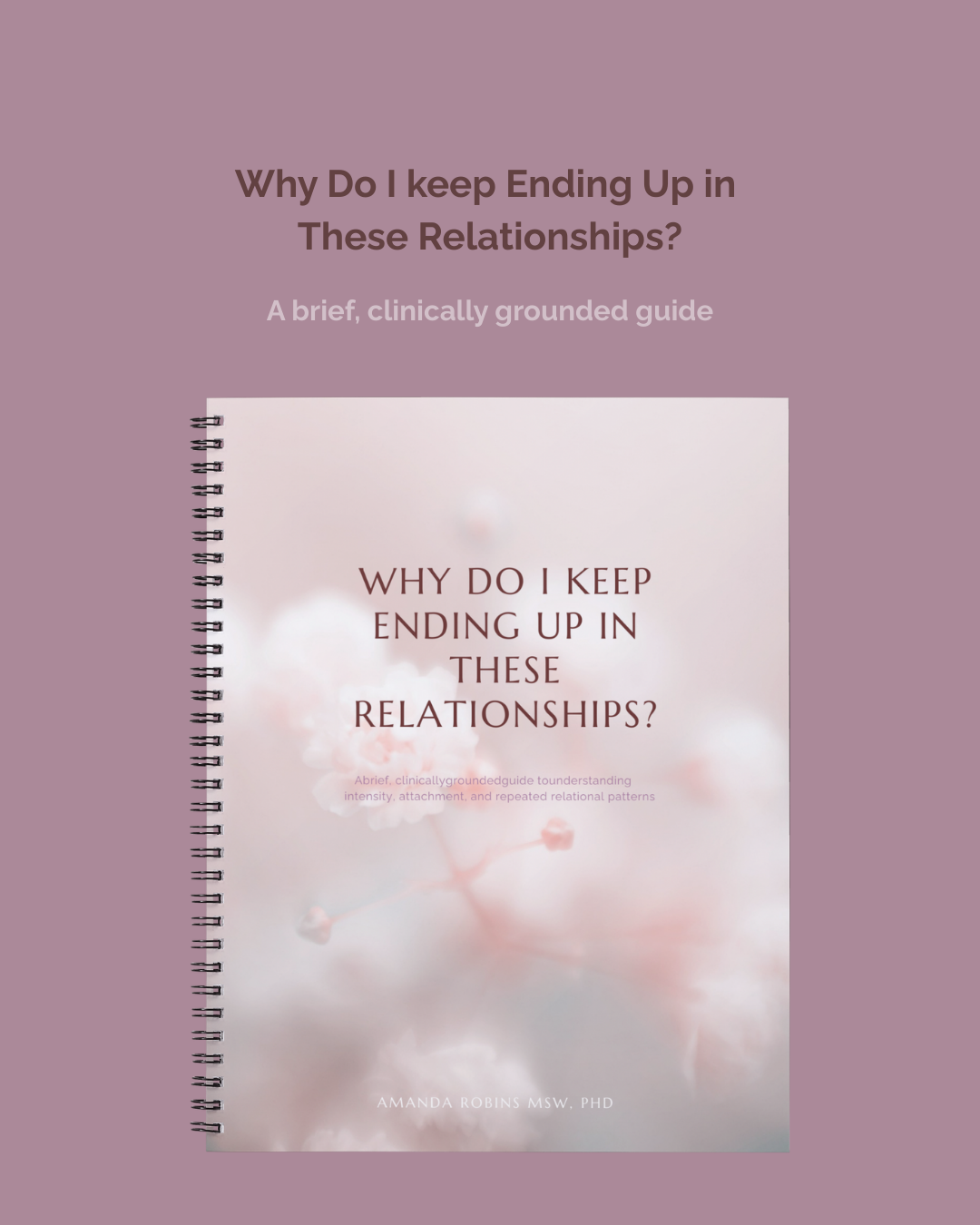
If you are trying to understand why relationships characterised by intensity, idealisation and emotional confusion have felt familiar, you may find this short guide helpful.
Why Do I Keep Ending Up in These Relationships? is a brief, clinically grounded guide to understanding attachment, intensity and repeated relational patterns.
Therapy for attachment and relationship difficulties
If attachment difficulties are affecting your relationships, understanding the pattern is useful. But sometimes understanding it isn’t enough.
Individual therapy can give you somewhere to explore what happens when you become close to another person, what happens when you feel rejected or vulnerable, and the ways you have learned to protect yourself in relationships.
It can also provide the opportunity to experience a different kind of attachment relationship, where your feelings can be thought about rather than dismissed, avoided or simply acted upon.
I work with people across Australia via Zoom.
MORE FROM OUR BLOG










Why is it so difficult to leave a narcissistic relationship, even when you know it is hurting you? This article explores the practical, emotional and psychological reasons people stay, including fear, isolation, gaslighting, earlier relationship patterns and the hope that things will change.