
When growing up with a narcissistic mother teaches you that being fully known is too dangerous.
If you’ve read much about the effects of narcissistic parenting, you’ve probably come across articles about anxious attachment, trauma bonds or repeatedly choosing emotionally unavailable partners.
Perhaps you’ve never recognised yourself in those descriptions.
You haven’t spent your life chasing relationships.
You haven’t tolerated obvious abuse.
In fact, you’ve often been the opposite, perhaps avoiding deeper engagement even when it is offered.
You’re capable. Independent. Thoughtful. Responsible. You have a successful career, good friendships and a life that, from the outside, appears stable and fulfilling.
Yet something never quite falls into place when it comes to intimate relationships. Perhaps you’ve remained single for years, despite wanting a partner. Maybe every relationship eventually feels disappointing. You may be asking yourself why nobody ever seems quite right.
If all of this sounds familiar, its possible that youre not afraid of relationships. You may actually be afraid of being fully known.
It wasn’t safe to be yourself.
Growing up with a narcissistic mother often means learning very early that love is conditional. Some parts of you are welcomed.
Others parts were criticised, ignored, mocked or quietly withdrawn from.
You may have been praised for being helpful, successful, agreeable or mature beyond your years.
But what happened when you were frightened, when you needed soothing or support or when you had feelings that didnt fit into the perfect picture your parents projected. Did anyone help you understand those feelings, or did you quickly learn they were inconvenient?
Children don’t simply learn how other people see them.
They learn which parts of themselves are allowed to exist.
Without realising it, many daughters begin organising themselves around the qualities that preserve the relationship. The rest of their true self gradually disappears from view.
Not because they dont exist.
But because it doesnt feel safe to have them.
You might never have learned that someone could love the whole of you.
One of the saddest consequences of conditional love is that you never experience yourself as a complete person. Instead, you become divided. The competent part.
The caring part.
The successful part.
The self-sufficient part.
Those parts become familiar, but the frightened child, the dependent woman, the part that makes mistakes and the part that sometimes needs reassurance are often suppressed.
Those parts remain hidden, not only from other people, but often from yourself.
Over time, this creates an unconscious expectation.
If someone really knew all of me…
they couldn’t possibly love me.
Not because you’ve consciously decided this.
Because your earliest relationships taught your nervous system that acceptance depended upon hiding certain parts of yourself. You gradually learn to fear your own “dark side”, your imperfections and the inconvenient parts that no-one ever recognised.
Competence can become a place to hide.
Many daughters of narcissistic mothers become remarkably capable adults.
They solve problems.
Care for others.
Build successful careers.
Create beautiful homes.
Raise thoughtful children.
Appear calm under pressure.
These are genuine strengths.
But sometimes they also become a refuge.
If I am always competent…
perhaps nobody will discover the parts of me that once felt unacceptable.
This isn’t pretending.
It isn’t manipulation.
It’s an adaptation.
The very qualities that helped you survive childhood may later make emotional intimacy much more difficult.
Learning to accept all parts of yourself
One of the hardest consequences of growing up with a narcissistic mother is that you learn to value only certain parts of yourself. You may have become highly competent, independent or successful, while believing that your needs, vulnerabilities or imperfections were somehow unacceptable.
Developing self-compassion isn’t about lowering your standards or giving yourself excuses. It’s about learning to accept yourself as a whole person, rather than believing you have to earn love through endless achievement or self-sacrifice.
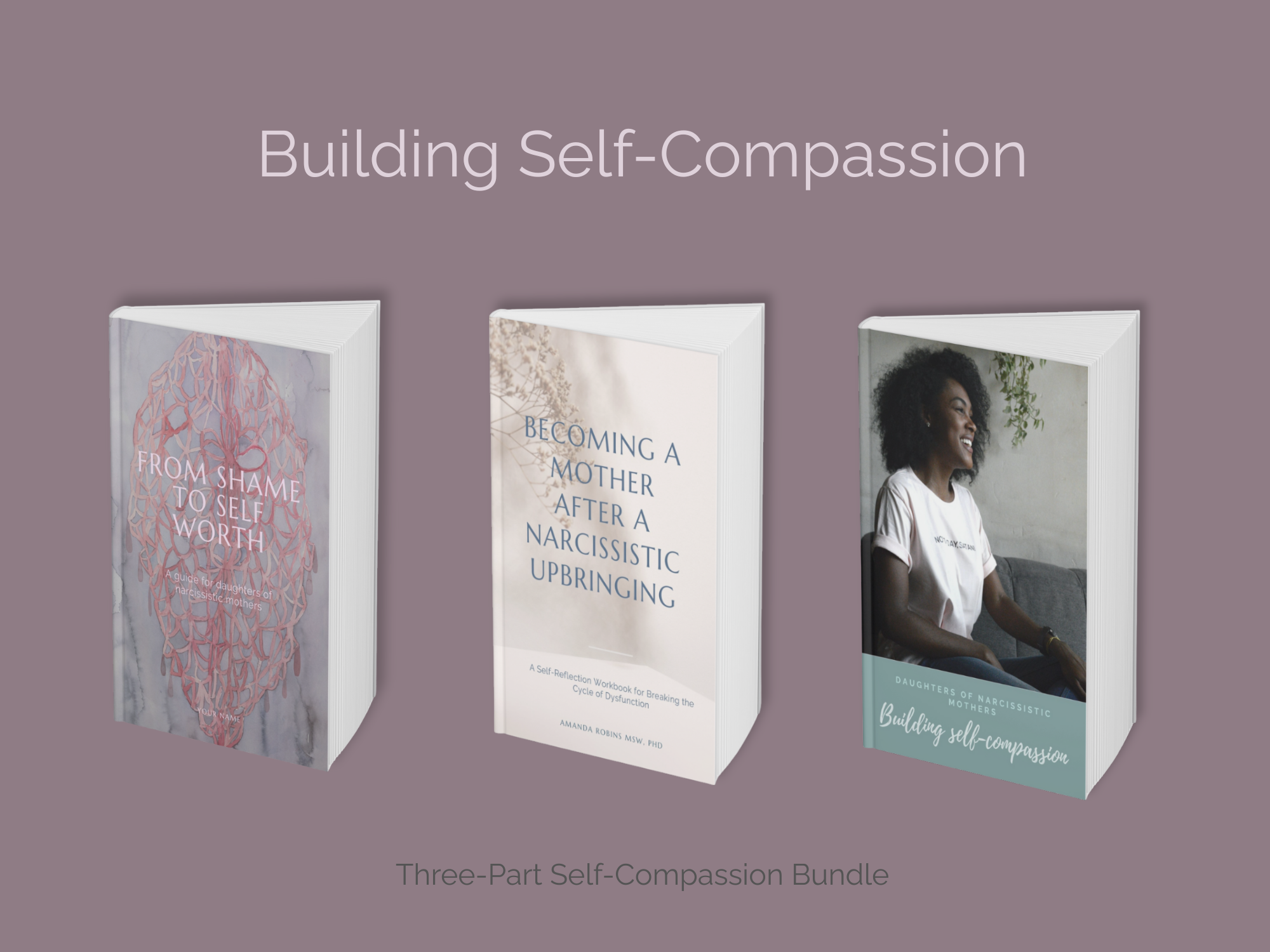
If you’d like support with this, my Self-Compassion Bundle explores how shame develops, why the inner critic can be so relentless, and how you can begin building a kinder, more accepting relationship with yourself.
Why nobody ever seems good enough.
Many women assume they simply have impossibly high standards.
Sometimes that’s true.
But perfectionism often serves another purpose.
If no relationship is ever quite right…
you never have to risk being completely known.
Sometimes women with these patterns unconsciously choose emotionally unavailable partners.
Sometimes they choose perfectly decent people who inevitably disappoint them in ordinary human ways.
No partner can remain endlessly insightful, emotionally attuned, patient and available.
Real intimacy involves misunderstanding, repair, disappointment and forgiveness.
If your earliest relationships taught you that mistakes led to rejection rather than repair, ordinary disappointments can begin to feel like confirmation that nobody will ever truly understand you.
The hidden loneliness of independence.
One of the greatest tragedies is that these women are often admired.
People describe them as resilient.
Independent.
Strong.
Self-contained.
Few people recognise how lonely that strength can become.
They become exceptionally good at caring for everyone else.
Much less comfortable allowing someone else to care for them.
Receiving love means surrendering some control.
It means allowing another imperfect human being to see you when you’re uncertain, frightened, disappointed or dependent.
For someone who grew up believing those parts of themselves were unacceptable, that can feel extraordinarily risky.
Healing isn’t about becoming less capable.
The goal of therapy isn’t to make you less independent.
Or less successful.
Or less thoughtful.
Those qualities are part of who you are.
Healing means gradually discovering that you don’t have to earn love by remaining endlessly competent.
It means learning that another person can know your strengths and your vulnerabilities.
Your confidence and your uncertainty.
Your generosity and your anger.
Your independence and your need.
In other words, therapy isn’t about becoming a different person.
It’s about becoming a whole person.
You don’t heal by becoming less capable. You heal by discovering that you no longer have to hide the parts of yourself that once felt impossible to love.
If you’ve recognised yourself in this article, you may also find my free Relationships Guide helpful. It explores why so many daughters of narcissistic mothers struggle with intimacy, boundaries and choosing emotionally healthy partners.
Continue Your Healing Journey
Recognising these patterns is often the beginning of change.
The next step is learning how to reconnect with the parts of yourself that had to be hidden, understand the lasting effects of narcissistic parenting, and begin building relationships based on authenticity rather than survival.
If this article resonated with you, my flagship online course, Reclaim Your Authentic Self, offers a structured and compassionate path towards lasting healing.
Through a series of practical lessons and reflective exercises, you’ll develop a deeper understanding of how your early relationships shaped your adult life—and, more importantly, how you can begin creating a different future.

MORE FROM THE RECOVERY ROOM





Why is it so difficult to leave a narcissistic relationship, even when you know it is hurting you? This article explores the practical, emotional and psychological reasons people stay, including fear, isolation, gaslighting, earlier relationship patterns and the hope that things will change.