

Why Narcissists Are So Attractive — and Why the Attraction Fades Over Time
You’ve done all the work. You’ve been there & done that. You’ve come to know yourself and your past, but you still can’t resist those delicious grandiose men.
Like an incredibly rich black forest gateaux, they look great, taste amazing, but after a while the glamour palls. After a few weeks of chocolate and cream, you crave a good old-fashioned chicken salad with freekeh.
But why, oh why do you still find yourself looking into the refrigerated shelves, staring longingly at the layers of dark chocolate, cream and sour cherries?
Narcissism researchers Brunell and Campbell liken having a relationship with a narcissist to eating chocolate cake. It might be appealing in the short term, but over time it is a very bad idea:
“The [narcissist’s] partner has a positive initial experience and negative long-term experience… This is the natural downward spiral of getting involved with a narcissist.”
Narcissists — especially the grandiose type — are initially incredibly attractive. They project an aura of sexy confidence and draw an admiring crowd. Eventually most people get bored… or fed up… or recognise they are being love-bombed and gaslit. But those of us with narcissistic parents are often more vulnerable to the pull.
The Different Types of Narcissists (And Why They’re Hard to Recognise)
Not all narcissists look the same. Some are loud and charismatic. Others are quiet, wounded, spiritual, or intensely intellectual. Many daughters of narcissistic mothers find these subtler forms even harder to identify.
Below are the most common real-world narcissistic styles clients report — and the red flags to look out for.
The Grandiose Narcissist (“The Classic Charmer”)
Initial appeal: charisma, confidence, magnetism.
Red flags: entitlement, cruelty disguised as humour, impatience, superiority.
The Cerebral / Intellectual Narcissist
Highly verbal, analytical, charming through intellect.
Clients call this the “intellectual narcissist.”
Initial appeal: interesting, articulate, deep.
Red flags: condescension, “debating” instead of relating, dismissing feelings, superiority disguised as intelligence.
The Spiritual / Communal / Virtue Narcissist
Also known as:
spiritual narcissist
virtue narcissist
communal narcissist
Initial appeal: values-driven, “good person,” emotionally articulate, helpful.
Red flags: hypocrisy, image-management, moral superiority, using “therapy language” to invalidate (“your triggers are your responsibility”).
The Vulnerable or Covert Narcissist
Self-effacing, wounded, anxious.
Initial appeal: softness, vulnerability, emotional depth.
Red flags: playing victim, passive-aggressive sulking, dependence that becomes entitlement.
Universal Red Flags Across All Types
intensity too fast
inconsistent behaviour
defensiveness when you state a need
poor empathy
rage or cold withdrawal when boundaries appear
using you for validation, regulation, or admiration
If you grew up with a narcissistic mother, these dynamics feel familiar. That familiarity reads as chemistry — and that’s where danger lies.
Noticing a pattern in your relationships?
My short, clinically grounded guide explores why some relationships feel intense, confusing, or hard to leave — and why these dynamics can feel familiar even when they cause distress.
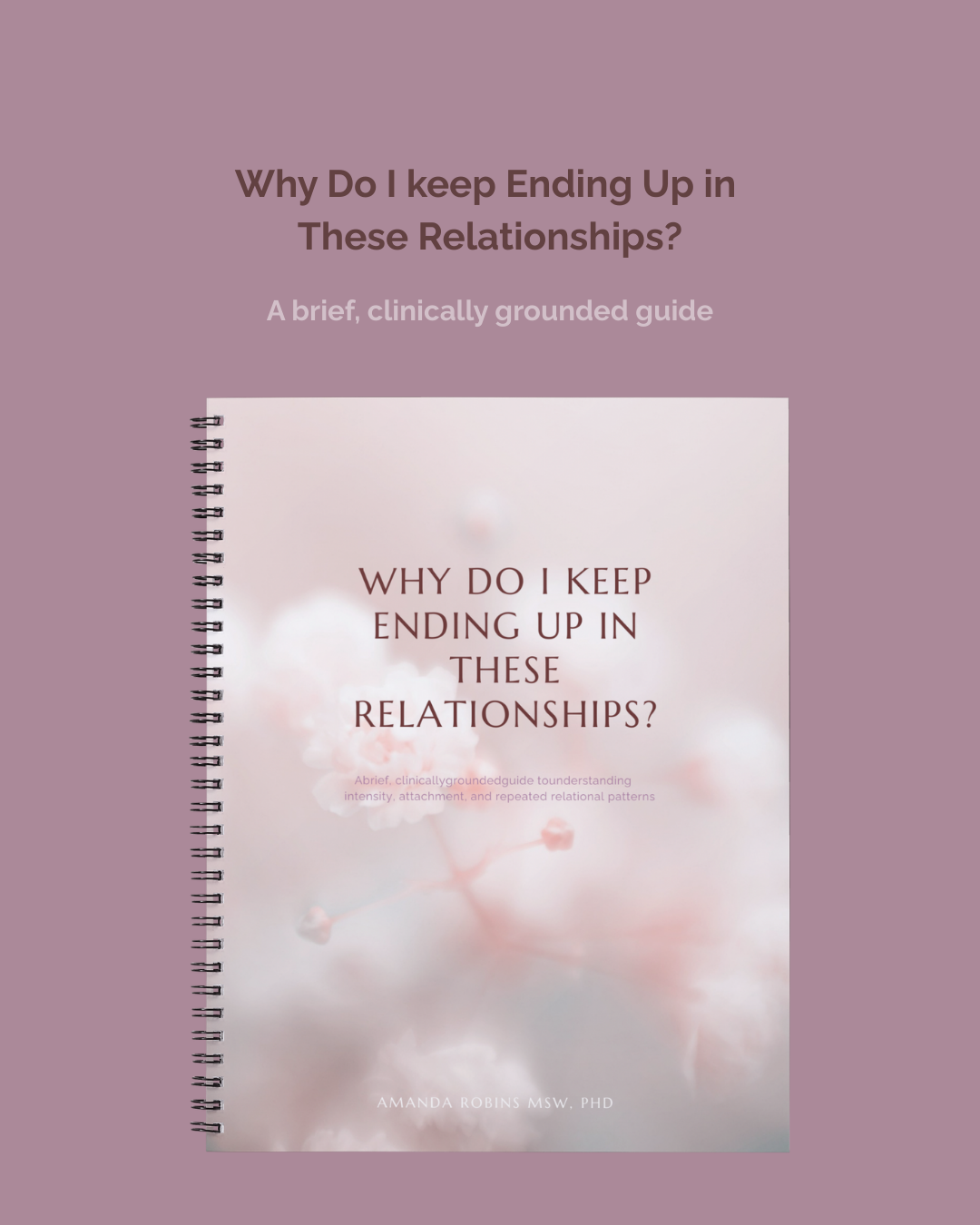
My Free Guide to Relationship Patterns for Daughters of Narcissistic Mothers
You can learn more about this dynamic in The Narcissistic Mother Wound.
When Attraction Becomes Exploitation
In their study of narcissism and romance, Brunell and Campbell found that partners of narcissists experience a drastic downward shift over time:
“Participants revealed that the narcissistic partner was self-centred, materialistic, deceptive and controlling… They felt used and played.”
Narcissists are highly effective at relationship initiation — far less effective at maintaining closeness, reciprocity, or emotional intimacy.
Of course, everyone puts their best foot forward at the beginning of a relationship. But for narcissists, the gap between the facade and reality is not a crack — it is a chasm.
Narcissists manage their self-image through the responses of others. They value you, but not because you are inherently valuable. They value you because you make them feel valuable.
This means you can be idealised one moment… and devalued or discarded the next.
Fusion, Fantasy and the Narcissist’s “Love”
As Sandy Hotchkiss notes in Why Is It Always About You? the narcissistic fantasy of fusion — the idea of becoming “one” — is not romantic; it is annihilating.
For mature adults, early fusion gives way to differentiation and deeper connection.
For narcissists, differentiation is intolerable.
They need sameness.
They need dominance.
They need control.
The moment you show independence, need support, or fail to adore them, they feel shame — and you become the target.
Eleanor Payson describes this as “the obliteration of the partner’s autonomy.”
Why Am I Attracted to Narcissists?
If you grew up with a narcissistic, emotionally unavailable or unpredictable parent, your early relationships may influence what you expect from relationships as an adult. But this doesn’t mean you are somehow programmed to find narcissists attractive.
Narcissistic people can be genuinely appealing at the beginning of relationships. Confidence, charisma, intensity and focused attention can be attractive to almost anyone. Your childhood history may become more important in what happens after the initial attraction.
Early relationships help shape our expectations about intimacy: whether our needs will be taken seriously, whether disagreement is safe, whether another person will remain emotionally available when we disappoint them, and how much of ourselves we need to give up in order to stay connected.
If you grew up accommodating a narcissistic parent, for example, you may have become particularly skilled at monitoring another person’s moods, explaining away hurtful behaviour or putting your own needs aside. These strategies may once have helped you maintain an important relationship. In adulthood, however, they can make it harder to recognise when a relationship has become persistently one-sided.
This is one reason I’m cautious about simply saying that people with trauma histories are “attracted to what feels familiar.” Familiarity may be part of the picture, but attraction, staying in a relationship and finding it difficult to leave are not necessarily the same thing.
Research increasingly suggests that the relationship itself matters too. (As one would expect.) A responsive partner who is interested in your experience and able to tolerate your separateness can create a very different relationship from someone who responds to your needs or boundaries with withdrawal, criticism or blame.
So the more useful question may not only be “Why am I attracted to narcissists?” but also: “What happens to me once I’m in a relationship, and what happens between us?”
Breaking the Attraction Cycle
Breaking a repeating relationship pattern isn’t simply a matter of becoming better at spotting narcissists. It can involve understanding what happens to you in relationships — what you expect, what you fear, what you find difficult to ask for, and what you do when connection feels threatened.
It also involves paying attention to what the other person actually brings to the relationship. Do they show curiosity about your experience? Can they tolerate disagreement? Do they respond to your needs without making you feel guilty for having them? Can both people remain separate individuals while still feeling connected?
The aim isn’t to become perfectly healed before you can have a healthy relationship. It is to become increasingly able to recognise the difference between intensity and intimacy, familiarity and safety, and attraction and genuine reciprocity.
For a deeper look at trauma-driven attraction, you may also want to read Trauma Bonds.
If reading here has helped you understand what you’ve lived through, that may be enough for now.
If you’re feeling stuck, overwhelmed, or caught in familiar patterns despite that understanding, working with someone directly can help contain and deepen this work.
An initial session is a place to think things through — not a commitment to ongoing therapy.
MORE FROM THE RECOVERY ROOM BLOG











Why is it so difficult to leave a narcissistic relationship, even when you know it is hurting you? This article explores the practical, emotional and psychological reasons people stay, including fear, isolation, gaslighting, earlier relationship patterns and the hope that things will change.